
Why client delivery breaks at the handoffs
Most client delivery breaks between roles, not inside tasks. Replace late-night heroics with three-point handoff readiness checks that hold under growth.


Where delivery drag actually hides in a growing company
Summary answer. Operational Efficiency breaks down in growing founder-led companies when work passes between roles through informal conversations instead of clear readiness gates. Replacing personal heroics and disconnected software workarounds with three-point handoff checks protects delivery quality, stops silent rework from draining margin, and prepares your floor for higher volume.
Monday morning inside a last-minute client rescue
It is 8:30 on a Monday morning, and a long-standing client has just emailed to ask why Friday's deliverable missed two requirements they discussed on the kickoff call three weeks ago. Within ten minutes, you are reading across four separate Slack channels, a project board with outdated statuses, and a forwarded email thread trying to piece together where the details dropped.
Nobody on your team slacked off. Whoever led sales captured notes in one document, the account lead summarized them from memory in a quick chat message, your specialist worked hard all week against incomplete inputs, and nobody noticed the gap until the client opened the file. To protect the relationship, you pull two senior people off their scheduled Monday priorities for four hours of unbilled rework and call the client yourself at noon to smooth things over.
Everyone worked late, everyone cared about the outcome, and your calendar just absorbed another avoidable fire. Client delivery still relies on personal heroics and informal workarounds rather than connected, repeatable workflows.
How informal handoffs drain Cash Flow and Projections and erode Culture
A business is one connected system. A visible symptom in one pillar rarely starts there. Founders often tolerate messy internal handoffs as long as clients eventually receive good work, missing the quiet damage informal workflows inflict on two other pillars every single month.
"Your cash pressure may not be a sales volume problem. When delivery workflows and handoffs stay informal, unpriced scope creep and rework quietly drain margin weeks before client invoices clear."
Every hour a senior specialist spends chasing missing intake files or redoing a deliverable is an hour you paid for on payroll that cannot be billed twice—and every delayed sign-off pushes client cash collection further to the right. At the exact same time, informal workflows wear down morale across your team: "Inconsistent standards rarely start as an attitude problem. When 'what good looks like' lives only in the founder's head, the team has to guess—and quality drifts whenever you step out of the room."
Look at why Operational Efficiency sits third in Ryder's foundational sequence when several pillars face equal strain: Cash Flow and Projections comes first to give you forward runway, Team Setup comes second so clear leads own outcomes, and Operational Efficiency locks in third before you pour more demand through Target Market or set bigger bets in Strategy. Pouring twenty percent more volume into unguarded handoffs does not scale profit; it multiplies rework.
A quick self-check on your delivery floor's real capacity
Diagnosis before prescription. Before shopping for another workflow app or adding delivery headcount, take an honest read of how client work travels across your company today. Rate the two Business Bottleneck Test statements below from "Rarely true today" to "Consistently true today":
- "Client delivery quality holds steady even when volume increases by 20 percent or more."
- "Our core workflows, handoffs, and software tools connect cleanly instead of relying on informal heroics."
Then trace your last five completed client engagements against four practical diagnostic questions:
- Where in your delivery chain does the receiving person most often have to message a teammate—or walk to your desk—just to find out what was promised or where files live?
- Can a downstream team member pause an incomplete handoff using an agreed checklist, or are they expected to absorb messy inputs and figure it out after hours?
- If signed client volume jumped by twenty percent next month without your personal overtime, which single stage of delivery would back up first?
- How many days typically pass between the moment delivery finishes a milestone and the moment finance actually sends an accurate invoice?
Founder dependency is a structural design gap, never a character flaw—and when you act as the human router connecting one department to the next, the workflow is still living inside your head.
Four steps to replace delivery heroics with clean handoffs
Building repeatable Operational Efficiency does not mean turning creative or technical professionals into assembly-line robots. Leave room for craft inside the work, and make the handoffs between stages crisp, visible, and unmistakable across four practical steps.
1. Map the four to six seams, not every micro-task
Put your entire client journey on one horizontal page using no more than six boxes—typically agreement signed, client onboarding, core production, internal quality review, client sign-off, and billing closeout. Ignore what happens inside each box for now and circle the arrows between them. Look back over the last thirty days of late-night fixes, client apologies, or margin write-offs: almost all of them will cluster around one single arrow.
2. Install a three-point readiness gate on the costliest seam
A handoff fails whenever the sender defines "done" differently than the receiver defines "ready to start." Sit the sender and receiver down together for twenty minutes and write a three-point readiness check—the minimum non-negotiable inputs that must be complete and verified before ownership crosses the line. Give the receiving lead explicit permission to return any handoff missing one of those three items rather than quietly guessing.
3. Stress-test capacity against a twenty percent volume surge
Do not wait for a busy quarter to find out where quality cracks. Walk your leads through a calm tabletop test: if five new best-fit engagements landed on Monday morning—a twenty percent step-up in active load—which role, approval, or review gate would bottleneck first without anyone working nights or weekends? Fixing that single choke point ahead of demand turns future growth from an emergency into a routine step-up.
4. Connect existing tools to the defined seam before buying new ones
Software and AI never replace human judgment; there is always a human in the room. Once a readiness check works cleanly on half a page for three weeks in a row, wire that exact three-point gate into the project or billing tool your team already opens every day—one source of truth per handoff, zero duplicate trackers, and zero shiny platforms purchased to mask an unspoken rule.
Copy this One-Page Handoff Readiness Gate and put it on your single highest-friction transition this week:
- Handoff seam: Exact transition point (for example, Signed Agreement to Delivery Kickoff, or Production Complete to Quality Review).
- Sending owner and receiving owner: One named role handing off and one named role accepting ownership.
- Readiness check 1 (complete inputs): The exact signed scope, client files, or technical specs attached in one agreed location—zero verbal side-deals left in email.
- Readiness check 2 (constraints and red flags): Margin guardrails, promised delivery date, and any approved exceptions stated in three plain lines.
- Readiness check 3 (definition of done for the next stage): Clear confirmation of what the next milestone looks like and when internal review happens before the client sees it.
- Return-to-sender rule: If any of the three checks is incomplete, ownership stays with the sender until resolved—never patched silently at night by the receiver or escalated to the founder.
What tightening one handoff looks like on a real floor
An illustrative example: Consider the founder of an established specialty contracting and design-build firm with thirty-five employees across estimating, project management, and field crews. Revenue was steady, yet gross margin kept slipping between the estimate and final job closeout, and the founder spent every Thursday evening driving to job sites or mediating tense phone calls between estimators and field superintendents.
At first, he assumed he needed better project-management software and stricter field supervision. When he traced the last six margin-leaking jobs backward, however, the crews were doing solid craft—almost every costly delay started at the single handoff between signed estimate and field mobilization, where verbal site assumptions and unverified material lead times were tossed over the wall under time pressure.
Instead of buying new software, he brought his lead estimator and senior superintendent into one room to write a three-point readiness gate: no job moved onto the field schedule without verified site measurements, locked material delivery dates, and a signed scope summary in the crew folder. Within one quarter, field rework dropped sharply, final milestone invoices went out days earlier, and the founder stopped spending Thursday nights acting as the translator between his own departments.
The goal is a company that can carry more of itself.
Four operational traps that create busywork without relief
The right move at the wrong time creates a new problem. As you strengthen Operational Efficiency, avoid four common missteps that add friction instead of removing it.
Buying software or AI automation before defining the handoff on paper. Automating a broken or ambiguous transition simply moves incomplete work down the line faster, multiplying mistakes your senior people still have to unwind manually.
Documenting fifty steps at once instead of fixing the costliest seam first. Trying to map every workflow across the company in a single month exhausts your leads and produces binders nobody opens; fixing the single highest-rework handoff builds immediate breathing room and team buy-in.
Praising late-night rescues in front of the team. When leadership celebrates Friday-night heroics without asking which upstream handoff failed on Tuesday, you accidentally reward firefighting over clean preparation.
Making the founder the permanent quality inspector at the end of the line. Catching errors yourself right before client delivery protects one project while guaranteeing your team never builds an internal quality gate that holds when you are away.
Reflection: your one Monday-morning action
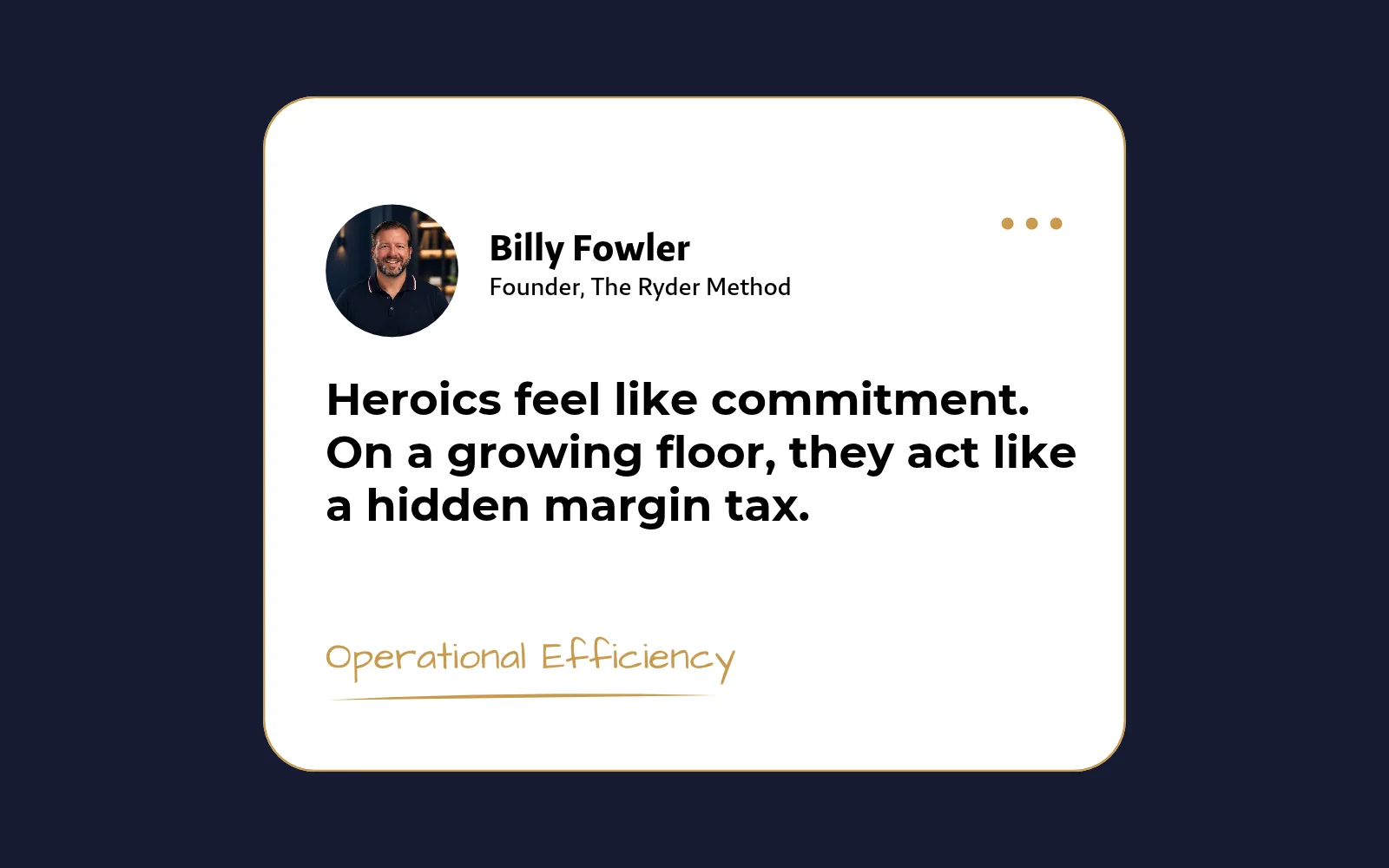
"Identify the single internal handoff that caused the most rework or late-night fixes over the past 30 days. Define one clear three-point readiness check required before that handoff moves forward."
One three-point gate enforced every Monday beats a hundred pages of documentation sitting untouched in a shared drive. Closing your costliest handoff leak immediately returns hours to your leads, protects gross margin on active work, and shows your team what calm operational order feels like.
Frequently asked questions about scaling delivery without heroics
How do I scale client delivery without quality dropping?
Focus first on the transitions between roles rather than policing how skilled specialists perform individual tasks. Quality usually slips when incomplete context passes from sales to onboarding or from production to review. Installing three-point readiness gates at each major seam ensures standards travel cleanly even when client volume rises.
Why didn't new project management software fix our operational bottlenecks?
Software tracks tasks, but it cannot invent missing agreement on ownership, scope boundaries, or quality standards. When a workflow is still informal, adding a new platform only creates another place for people to leave partial updates. Define who owns each handoff and what "ready" means on paper before configuring any tool.
How can I tell if my team is near delivery capacity before things break?
Watch leading indicators at the seams rather than waiting for missed client deadlines: rising internal revision rounds, senior leads working evenings to patch intake gaps, slower billing handoffs after work finishes, and routine questions routing back to the founder. Run a twenty percent volume tabletop check each quarter to spot the next constraint early.
How do operational rework and scope creep affect cash flow?
Unpriced scope creep and internal rework hit Cash Flow and Projections twice. First, payroll hours go toward fixing unbilled mistakes instead of advancing new billable milestones. Second, messy delivery delays client sign-off and invoice dispatch, widening the gap between fixed biweekly payroll going out and client cash clearing your bank.
Know where to begin across all seven pillars
Order matters more than effort. Sometimes Operational Efficiency is the true primary constraint taxing your margin and exhausting your team. Other times, delivery looks chaotic only because Target Market keeps letting custom one-off deals through the front door, Team Setup lacks clear decision owners, or Strategy has six competing initiatives pulling your leads in opposite directions on Monday morning.
Owner doesn't mean absent. It means choice. Where the Science of Business meets the Art of Living Fully, The Ryder Method walks founders through four deliberate steps—1) Get oriented, 2) See the full picture, 3) Know what matters now, and 4) Implement, measure, and adjust—with experienced human guidance beside you at every turn. Diagnose. Sequence. Implement.
Know what's creating the drag. Know where to begin. Take the ten-minute Business Bottleneck Test across seven connected pillars to see where pressure is collecting in your company, and your clearest starting point. Ten minutes, seven pillars, no sales pitch. Build the company. Become the owner.