
Why standards slip when you leave the room
Culture is what your team does when you are not watching. Turn unwritten expectations into visible standards so accountability holds and your life opens up.


What Culture actually means inside a founder-led company
Summary answer. In an established founder-led company, Culture is how your team upholds standards, flags issues, and cares for clients when you are not in the room. It is built through visible expectations, safe early problem-flagging, and calm leadership responses—never wall slogans—giving your company steady accountability and giving you your life back.
Monday morning after three days out of the building
It is 8:10 on a Monday morning, and you have just walked back into the office after taking Thursday and Friday away for a family milestone. Nothing burned down while you were gone, yet within twenty minutes of opening your laptop you can feel the subtle sag that settled over the floor in your absence.
A client onboarding packet went out with two small sloppy errors nobody caught, a minor vendor hiccup from Thursday morning sat untouched in a shared inbox waiting for your return, and a team meeting ran flat without anyone stepping forward to make a routine call. Everyone on payroll is kind, capable, and genuinely loyal to the company, yet your personal energy still acts like the invisible gravity holding the quality bar in place.
You close your office door wondering how you can ever take real time off if stepping away for forty-eight hours softens the edge you spent years building. Standards hold when you are personally in the room, yet team initiative and accountability soften when you step away.
Why culture is built out of structure, not wall posters
When founders notice initiative slipping, standard leadership advice usually points toward morale exercises: host an offsite to paint five core values on the conference-room wall, give a rousing town-hall speech about taking ownership, or add team perks to boost engagement. Two weeks after the offsite, the framed values blend into the drywall and the exact same hesitation returns on Tuesday afternoon.
Replacing people rarely solves it either, and the labor market leaves thin margin for avoidable turnover: in the Federal Reserve Banks' 2026 Report on Employer Firms, hiring or retaining qualified staff remained the second most common operational challenge across U.S. employer businesses right behind reaching customers and growing sales. Most established founders do not employ lazy people—they employ careful people operating inside invisible rules.
Your business grew. The structure underneath it didn't. When your company had five people within earshot of your desk, they absorbed your standards by osmosis—watching your facial expressions on client calls, hearing which details you double-checked, and seeing how you handled a mistake in real time. Effort built the business. Structure scales it.
Once your team spans multiple leads, shifts, or locations, osmosis stops reaching the edges of the building. Where unwritten expectations take over, conscientious employees slow down and wait for permission rather than risk guessing wrong. Hesitation that looks like an attitude problem from across the room is almost always an unwritten-expectation problem up close.
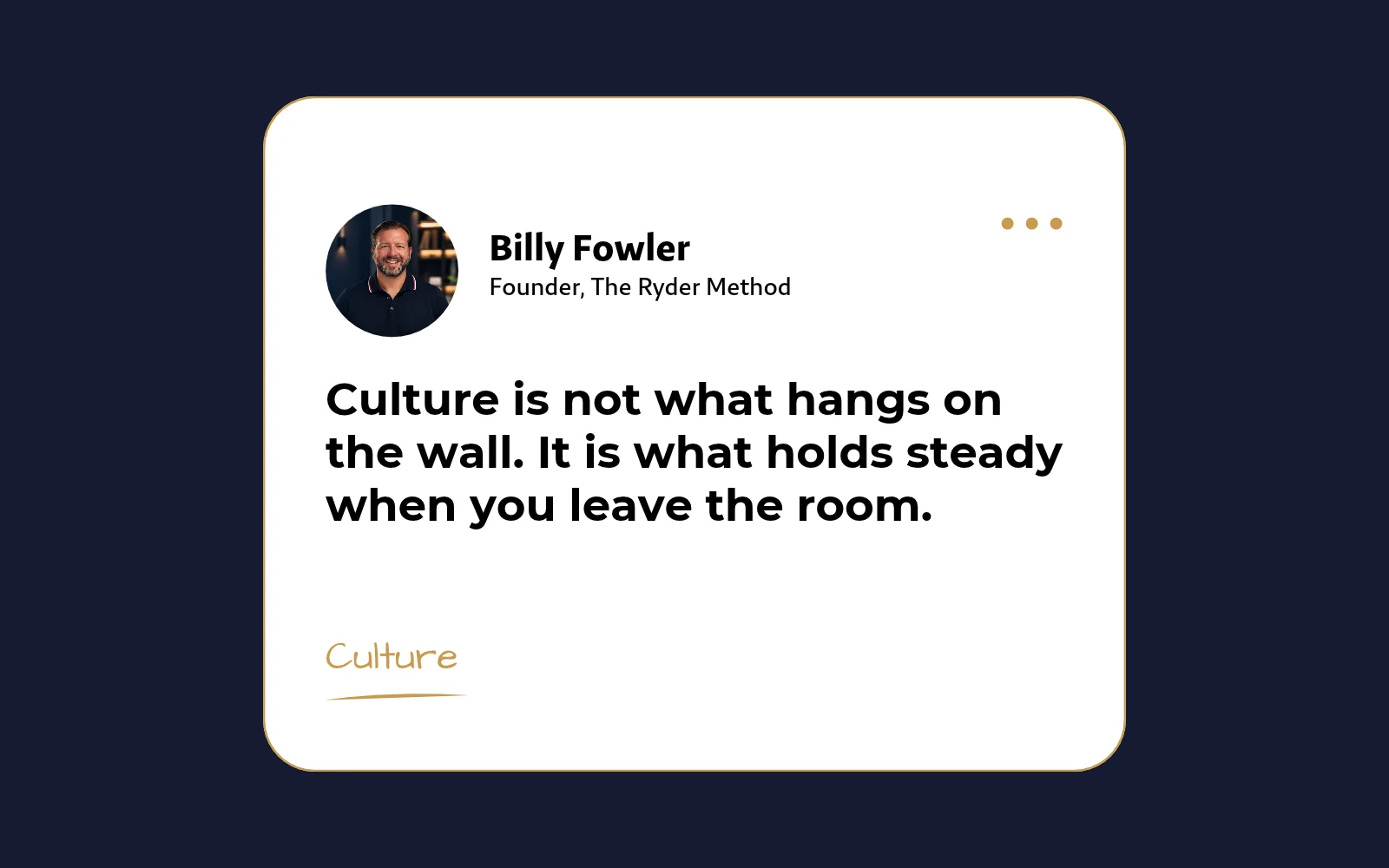
Culture is not what hangs on the wall. It is what holds steady when you leave the room.
How Operational Efficiency and Culture reinforce each other
A business is one connected system. A visible symptom in one pillar rarely starts there. Founders frequently treat Culture as a soft, emotional topic detached from daily workflows, missing how directly team accountability rises or falls on the clarity of Operational Efficiency.
"Inconsistent standards rarely start as an attitude problem. When 'what good looks like' lives only in the founder's head, the team has to guess—and quality drifts whenever you step out of the room."
Look at what happens when quality lives exclusively inside the founder's personal taste. Because nobody else has a concrete, observable benchmark to measure their work against before sending it forward, your presence becomes the company's only calibration instrument. When you are in the building, people tighten up because the instrument is watching; when you leave for a long weekend, people revert to their own individual definitions of "good enough," and small gaps multiply across handoffs.
Notice why Culture sits sixth in Ryder's foundational sequence when several pillars sit under equal strain: Cash Flow and Projections comes first to secure runway, Team Setup comes second to establish decision owners, Operational Efficiency comes third to lock handoffs, Target Market comes fourth, and Strategy comes fifth—before Culture and Big Show Event. Asking people for proactive ownership when cash is chaotic, roles blur, handoffs leak, and six priorities collide sets good people up to fail; installing clear structure underneath lets a strong Culture take root naturally.
A quick self-check on what holds when you are not watching
Diagnosis before prescription. Before rewriting values decks or questioning team commitment, examine what your current environment actually teaches people to do when something goes sideways. Rate the two Business Bottleneck Test statements below honestly from "Rarely true today" to "Consistently true today":
- "Team members proactively flag and solve problems rather than waiting for my permission."
- "Our operating standards and client care hold consistently even when I am not in the room."
Now reflect honestly on four everyday moments across your floor:
- The last time a team member brought you bad news early, did your visible first reaction make them glad they spoke up—or make them wish they had waited?
- Could a newer employee look at one clear reference example and verify on their own whether a client deliverable meets your company's bar before hitting send?
- When a deadline slips or a client complains while you are out of the office, do your leads run a post-mortem and fix the seam themselves, or leave the issue parked for Monday?
- Do you praise teammates publicly when they catch an upstream gap quietly on Tuesday, or save your loudest praise for people who rescue emergencies on Friday night?
Founder dependency is a structural design gap, never a character flaw—and a team's daily habits always mirror the standards made visible on paper and the reactions modeled by the leader.
Four steps to build a culture that carries the standard without you
Turning Culture from founder-policed compliance into shared pride does not require motivational speeches. Build it steadily across four practical leadership moves.
1. Translate values into observable behaviors and visible benchmarks
Abstract words like "excellence," "ownership," or "client-first" mean ten different things to ten different hires until you turn them into observable Monday behaviors. For every core client touchpoint and internal standard, show one concrete side-by-side comparison: what meets our bar, what falls short of our bar, and why. When "good" sits in plain sight, peers can uphold the standard with one another without turning you into the referee.
2. Reward early problem-flagging paired with a proposed fix
Silence kills growing companies faster than honest mistakes ever do. Establish one explicit house norm across every department: spotting a risk early and bringing it forward with one recommended fix is always rewarded, while hiding a problem until the client feels it is never acceptable. Backing that norm consistently turns twenty sets of eyes into proactive guardians of the company's reputation.
3. Audit how your own first thirty seconds train the room
In a founder-led business, your nervous system sets the weather in the building. If a lead brings forward an honest misstep and your first thirty seconds carry a sharp sigh, visible frustration, or an immediate takeover of the keyboard, the entire room quietly learns to play defense and wait for explicit permission next time. Pausing to ask calm diagnostic questions—we are asking, we are not assuming—treats mistakes as system data and trains adults to step forward rather than shrink back.
4. Connect strong culture directly to the Art of Living Fully
Where the Science of Business meets the Art of Living Fully, Culture is the bridge where operational architecture finally translates into human freedom. Financial dashboards, handoff gates, and 90-day plans build the frame, yet you will never truly close your laptop at dinner or unplug on a family trip until you trust that your people care about the standard as much as you do. A healthy, structure-backed Culture gives your team dignity in their craft and gives the founder her life back.
Copy this One-Page Visible Standard and Early-Flag Charter and complete it for three core standards with your leads:
- Core standard name: Plain-spoken title of the client or operating commitment (for example, Client Communication Speed, Field Site Cleanliness, or Proposal Precision).
- What meeting the bar looks like (observable): Two specific, measurable behaviors anyone on the team can verify without asking the founder.
- What falling below the bar looks like (observable): Two concrete drift signals we never let pass quietly across a handoff.
- Early-flag protocol: The moment a drift signal appears, who flags it, how they state their recommended fix in three lines, and who owns closing the loop.
- Leader response commitment: How leads and the founder respond in the first thirty seconds when an issue is flagged early—curiosity over blame, system fix over keyboard takeover.
What happens when unwritten expectations move onto paper
An illustrative example: Consider the founder of an established B2B advisory and accounting firm with twenty-eight staff members across three client pods. She cared deeply about client responsiveness and accuracy, yet every tax and audit season left her exhausted—personally spot-checking outgoing client memos at 8:00 p.m. and feeling quietly disappointed that her pod leads rarely flagged capacity bottlenecks until deadlines were already slipping.
During an honest one-on-one conversation, a trusted senior manager shared something that stopped her cold: the team stayed quiet until they were sure of every detail because whenever someone raised an early concern during busy weeks, the founder tended to look stressed and pull the file onto her own desk for the weekend—making the manager feel as though they had let her down.
Together with her three pod leads, she wrote a one-page visible standard for client deliverables alongside a simple Thursday early-flag check-in: any pod lead could raise a timeline risk four days ahead accompanied by a recommended reallocation, and she committed to keeping her hands off the file while coaching the call. Within two quarters, peer quality checks caught small errors before they ever left the pod, early flags surfaced calmly on Thursdays instead of exploding on Mondays, and she stepped away for a ten-day autumn trip without once checking outgoing client mail.
The goal is a company that can carry more of itself.
Four culture traps that keep founders policing the floor
The right move at the wrong time creates a new problem. As you strengthen Culture across your company, steer clear of four common traps that undermine real ownership.
Treating "we are a family" as a substitute for clear accountability. Warmth and care matter deeply, yet avoiding direct conversations about missed standards in the name of harmony quietly punishes your strongest performers who end up carrying the slack.
Punishing the messenger when a problem surfaces early. One frustrated outburst when a lead brings an honest mistake to your attention undoes six months of speeches encouraging proactive initiative.
Writing values statements without changing what gets tolerated or rewarded. Your real culture is defined by the lowest standard leadership walks past on a busy Wednesday and the behaviors you visibly promote.
Breaking your own operating rules whenever your calendar gets tight. If you ask your team to follow readiness gates and decision briefs while bypassing them yourself on rush requests, the team quickly concludes the standards are optional.
Reflection: your one Monday-morning action
Ask two key team leads one question individually this week: "Where are my expectations still living in my head instead of on paper?" Write down their answers without defending them.
Listening calmly and writing down what you hear does two jobs in twenty minutes: it reveals the exact blind spot causing hesitation on your floor, and it signals immediately to your leads that candor is safe in your room.
Frequently asked questions about culture and accountability
Why do company standards slip whenever the founder is out of the office?
Standards slip when quality benchmarks live inside the founder's personal judgment rather than in visible, shared operating rules. When you are present, your daily feedback acts as the quality filter. Documenting observable definitions of "done well" and clear peer review gates lets the standard hold steady without your supervision.
How do I get my employees to flag and solve problems proactively?
Combine clear decision guardrails with psychological safety around early bad news. Require team members to pair every flagged issue with one recommended next step inside their authority lane, and discipline your own initial reaction so early warnings are met with calm problem-solving rather than frustration or taking the task back.
How do you build real accountability without micromanaging a good team?
Micromanagement polices every keystroke during the work; healthy accountability agrees on the finished outcome, non-negotiable guardrails, and review cadence before the work begins. When expectations are explicit up front on one page, capable professionals welcome high standards because they have full freedom over how they execute inside the lane.
Why don't core values posters improve culture in a growing business?
Abstract nouns on a wall do not tell an employee how to handle a tense client trade-off at 4:00 p.m. on Friday. Culture only changes behavior when values are translated into specific operating habits, backed by clean workflows, and reinforced consistently by what leadership models, tolerates, and rewards every week.
See all seven pillars together and know where to begin
Order matters more than effort. Sometimes Culture is the exact constraint keeping you tethered to the building even after systems are written. Other times, what looks like a cultural hesitation on the surface is actually downstream pressure from tight Cash Flow and Projections, blurry authority in Team Setup, broken handoffs in Operational Efficiency, poorly matched clients in Target Market, scattered priorities in Strategy, or an unclear horizon in Big Show Event.
Owner doesn't mean absent. It means choice. Where the Science of Business meets the Art of Living Fully, The Ryder Method develops the founder and the company as one connected system across four deliberate steps—1) Get oriented, 2) See the full picture, 3) Know what matters now, and 4) Implement, measure, and adjust—always with an experienced human in the room beside you. Diagnose. Sequence. Implement.
Know what's creating the drag. Know where to begin. Take the ten-minute Business Bottleneck Test across seven connected pillars to see where pressure is collecting in your company, and your clearest starting point. Ten minutes, seven pillars, no sales pitch. Build the company. Become the owner.