
When founder-led sales become the growth ceiling
Founder-led referrals build traction, then become a ceiling. Learn how defining your best-fit client protects margin, delivery, and cash.


Why founder-led sales eventually stall a growing company
Summary answer. A growing founder-led company hits a ceiling when new revenue depends on the founder's personal network and custom scoping. Moving past founder-led sales requires defining your Target Market from operating evidence, naming the exact trigger that makes ideal clients call, and making your distinction obvious before a sales conversation starts.
Monday morning in a referral-built pipeline
It is 8:40 on a Monday morning, and your calendar already holds three prospective client calls that nobody else on your team could take. One came from a former client's text message over the weekend, one came through a peer group introduction, and the third is a returning account asking if your team can stretch outside its normal scope for a rush project.
Between meetings, a Slack message pops up from your operations lead asking what was actually promised on last Thursday's proposal, because the new client expects a deliverable your standard workflow does not cover. By 6:00 p.m., you still have two custom scopes sitting in your drafts folder waiting to be priced out of your own head.
On paper, demand looks healthy because people trust your name and pick up the phone. Underneath that activity sits a quieter operational truth: growth is still leaning too heavily on your personal network and custom scoping rather than repeatable demand from ideal-fit clients.
Why hiring a salesperson rarely fixes a blurry Target Market
When a founder gets tired of carrying every sales call, the standard advice from the market is predictable. Hire a business development rep, retain an outbound agency, or publish more content to fill the top of the funnel. In the Federal Reserve Banks' 2026 Report on Employer Firms, reaching customers and growing sales was the most common operational challenge firms experienced.
Most established founders try at least one of those prescriptions and watch it stall within two quarters. The new salesperson struggles to close without pulling you onto the call anyway, or closes poorly matched accounts that leave your delivery team scrambling. The agency books conversations with prospects who treat your work like an interchangeable commodity and push back on price.
Your business grew. The structure underneath it didn't. In the early stage of building a company, saying yes to wide-ranging problems and tailoring every engagement on the fly is how you survive and prove traction. Effort built the business. Structure scales it.
Once you have a real team on payroll, founder-sourced demand stops acting like an asset and starts acting like a ceiling. Founder dependency is a structural design gap, never a character flaw. When your Target Market is defined loosely as "anyone with a budget whom I can personally convince and custom-scope," only the founder possesses the institutional judgment to invent the offer in real time.
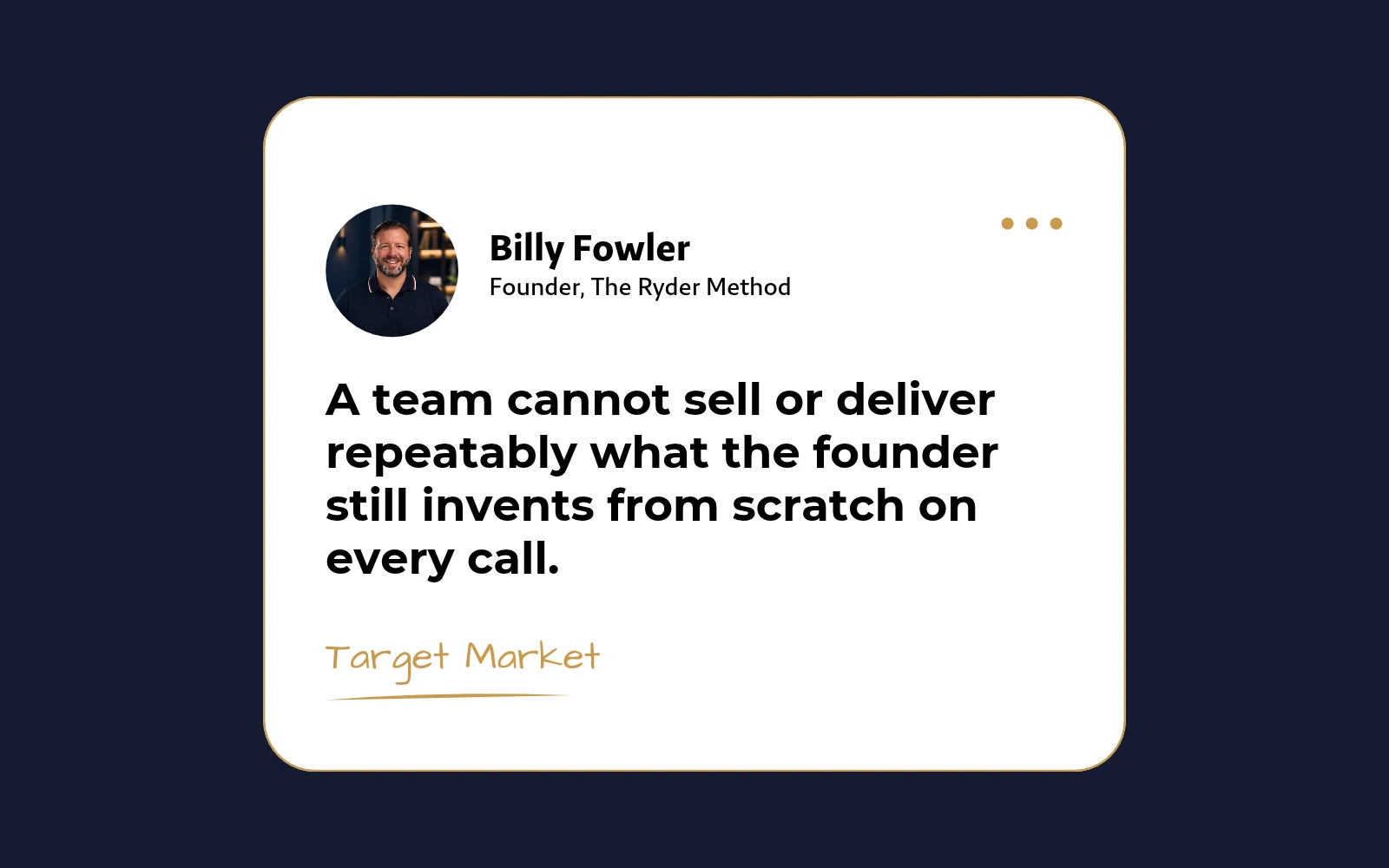
A team cannot sell or deliver repeatably what the founder still invents from scratch on every call.
A team cannot sell or deliver repeatably what the founder still invents from scratch on every call.
How saying yes to the wrong client shows up in Cash Flow and Projections
A business is one connected system. A visible symptom in one pillar rarely starts there. Founders often come looking at Target Market only when pipeline slows down, yet an unfocused Target Market quietly creates havoc even when revenue is climbing.
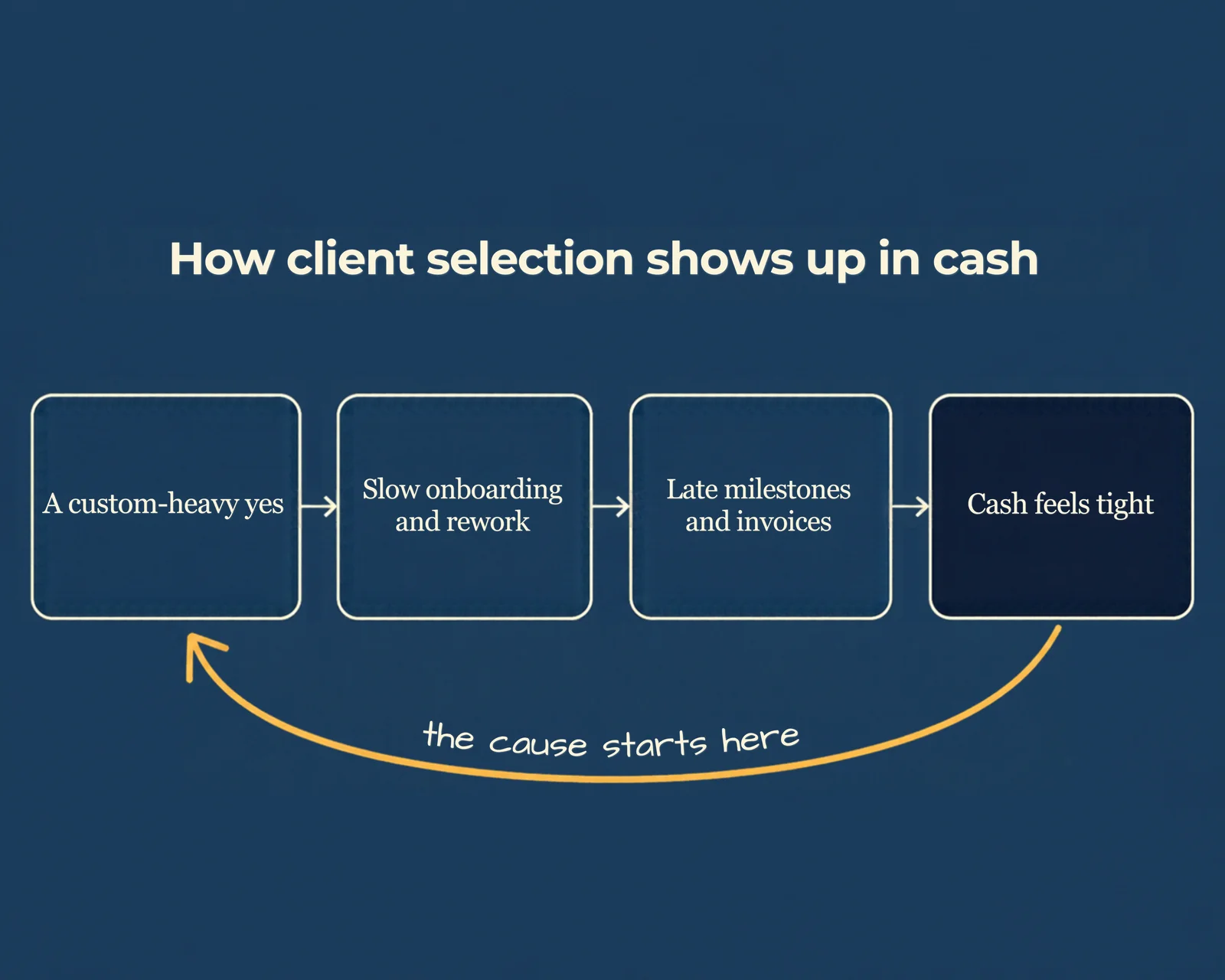
Cash tightness often begins upstream in client selection. Saying yes to poorly matched or custom-heavy engagements creates delivery drag and slows cash collection across the business.
Watch the chain reaction across a single quarter. You say yes to an enthusiastic referral who sits slightly outside your sweet spot, adjusting your normal deliverables to win the relationship. Because the engagement is custom, onboarding takes twice as long while your team waits on you to translate what the client actually bought.
Midway through delivery, expectations drift because your team has no written standard for this one-off scope. Senior staff spend unbilled hours reworking deliverables, regular accounts get less attention, milestone sign-offs slide by three weeks, and invoices go out late while biweekly payroll clears right on schedule.
What shows up on Friday afternoon as pressure in Cash Flow and Projections or burnout in Operational Efficiency was actually locked in weeks earlier during a thirty-minute discovery call. Note how sequence works in The Ryder Method: when multiple pillars are under equal strain, stabilizing Cash Flow and Projections, Team Setup, and Operational Efficiency often comes first so the business has steady footing, yet tightening who enters the front door is what keeps old margin leaks from refilling.
Where pressure is collecting in your pipeline today
Diagnosis before prescription. Before changing your marketing or hiring for sales, start with an honest read of how clients enter your company right now. Rate the two statements below from "Rarely true today" to "Consistently true today":
- "Our pipeline brings in well-matched, profitable clients without relying on my personal network or direct selling."
- "Prospects clearly understand why we are distinct before they ever join a sales conversation with us."
To sharpen that picture further, look across your active client roster and answer four practical diagnostic checks:
- If your personal phone and referral inbox went quiet for one quarter, would your company have a repeatable way to start conversations with well-matched buyers?
- Can your operations lead decline or re-route a prospect using written criteria without checking with your desk first?
- Do your last five signed agreements follow a recognizable core scope, or did three or more require custom pricing and custom delivery steps?
- On first-time sales calls, do prospects arrive asking how your specific approach works, or asking you to match a competitor's line-item quote?
If most of those answers point back to your personal involvement, your company has outgrown relationship-only demand.
Four steps to turn personal rainmaking into repeatable demand
Moving Target Market out of your head does not require a rebrand or a complicated marketing funnel. It requires translating your intuitive founder judgment into plain operating criteria your entire company can use. Build that clarity across four steps.
1. Define your best-fit client from operating evidence, not aspiration
Most ideal-client exercises fail because they describe a hypothetical dream buyer—usually larger logos that actually demand heavier customization and slower payment terms. Instead, audit your closed books and delivery floor. Look for the clients where gross margin held steady, your team delivered high-quality work without your rescue, invoices cleared on time, and the client valued your guidance. Those accounts reveal where your real structural advantage already lives.
2. Name the operational trigger, not just the industry label
Demographics and industry labels tell you what a company looks like from the outside, not why they buy on a Tuesday morning. Established buyers act when a specific operational event forces a decision: opening a second location, losing a key manager, failing a compliance check, or outgrowing an entry-level vendor. When your messaging and outreach name that exact trigger in plain words, right-fit prospects feel recognized immediately without needing your personal introduction.
3. Put the expensive yes on paper as hard disqualifiers
Every experienced founder carries scar tissue from deals that looked lucrative at signature and cost twice their fee in team exhaustion. Keep those lessons out of private memory and put them on paper. Write three to five non-negotiable red flags—such as prospects seeking bespoke work outside your core delivery lanes, buyers unwilling to share baseline data during discovery, or engagements below your margin floor—so anyone on your team knows when to walk away politely.
4. Establish pre-call distinction and bounded scoping
Prospects should understand what you solve, who you are built for, and how your approach differs before a discovery call begins. Pair one clear point-of-view asset—a diagnostic checklist, an architectural overview of your process, or an honest breakdown of common industry mistakes—with bounded offer parameters. When the problem, the criteria, and the guardrails are clear up front, a senior lead can qualify and scope engagements accurately without calling you into the room.
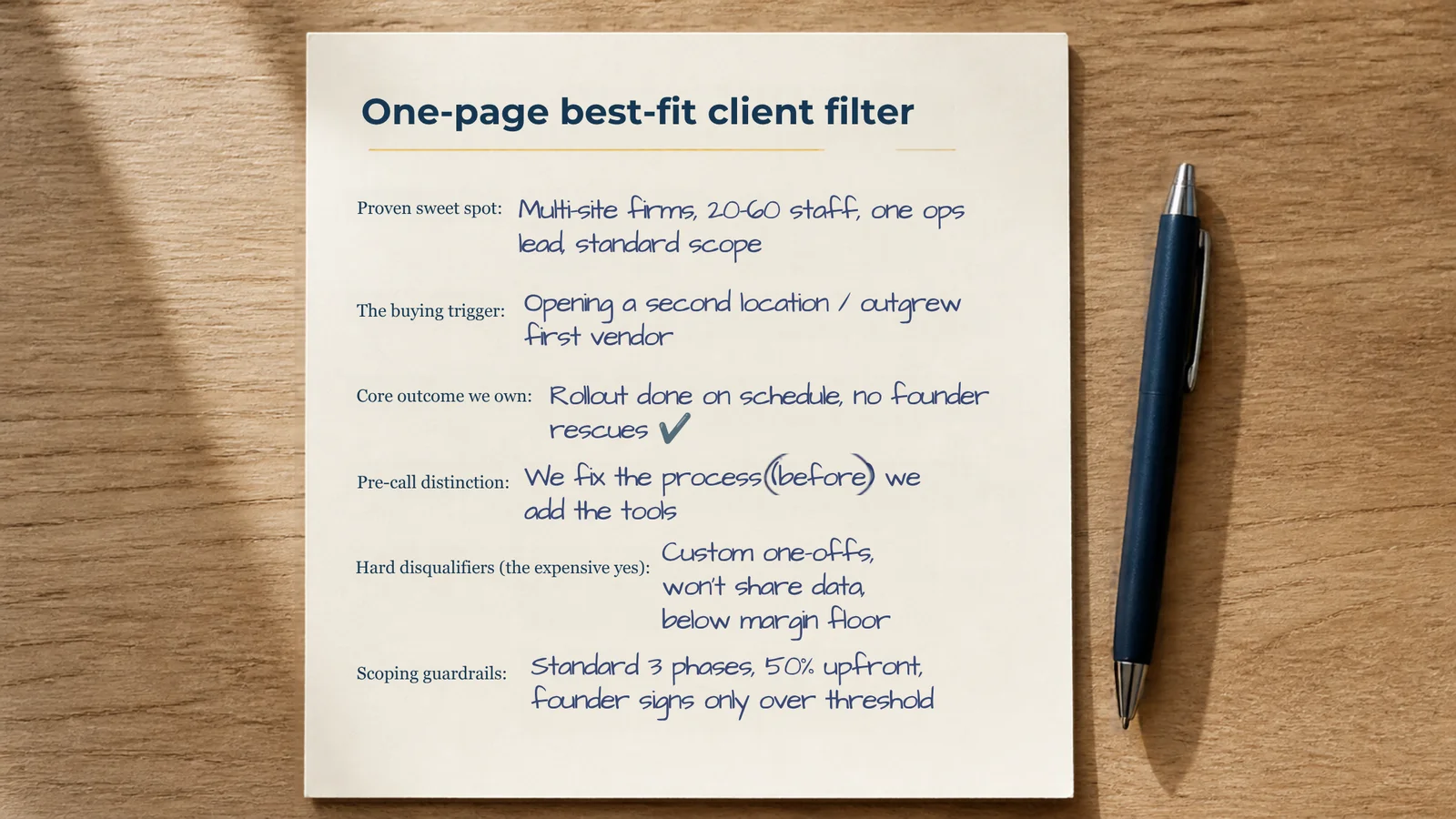
Copy this One-Page Best-Fit Client Filter and complete it with your leadership lead:
- Proven sweet spot (evidence-based): Stage, complexity, and operating environment of our top five cleanest, highest-margin accounts.
- The buying trigger: The specific event or breakdown happening inside their business the week before they reach out to us.
- Core outcome we own: The exact problem our existing team can solve at high quality without custom heroics from the founder.
- Pre-call distinction: The one belief or operating standard that separates us from commodity alternatives before pricing is discussed.
- Hard disqualifiers (the expensive yes): Three concrete conditions under which we decline or refer the prospect elsewhere, even in a slow month.
- Scoping guardrails: Standard delivery boundaries, payment rhythm, and the single threshold that requires founder sign-off.
What narrowing client selection looks like in practice
An illustrative example: Consider the founder of an established B2B technical services firm with two dozen employees. For years, growth came almost entirely through her personal reputation. Whenever a peer referred a company needing adjacent custom work, she stepped onto the discovery call, designed a tailored scope over the weekend, and handed the project to her delivery leads on Monday.
Her team stayed busy, yet margins felt unpredictable and she could not take a week offline without deals stalling and project managers escalating scope disputes back to her phone. When she reviewed her past year of accounts side by side, she noticed a clear split: engagements triggered by one specific operational transition ran smoothly under her leads, while custom side-projects consumed almost all of her late-night rescues.
She documented a one-page client filter around that single trigger, retired custom one-off proposals, and updated her pre-call intake so prospects saw her firm's exact scope boundaries before booking. Within a couple of quarters, her account director could run discovery against those written guardrails, delivery handoffs quieted down, and her own week opened up to lead strategy rather than price every exception.
The goal is a company that can carry more of itself.
Four client-selection traps that keep founders in every deal
The right move at the wrong time creates a new problem. As you tighten your Target Market, watch out for four common traps that pull founders right back into the bottleneck.
Hiring sales headcount before writing down your filter. Bringing on a closer to "figure out outbound" before you define triggers, disqualifiers, and scoping boundaries sets both the hire and your delivery floor up for expensive friction.
Mistaking a broad net for lower risk. When founders worry about pipeline, narrowing who they serve feels risky, so they keep website copy vague enough to include everyone. In practice, vague positioning makes you invisible to ideal buyers and forces you to rely even harder on personal favors and referrals.
Confusing top-line contract size with client fit. A large custom logo that demands non-standard workflows, constant founder reassurance, and extended payment windows often leaves less net cash in the bank than two smaller accounts that fit your repeatable system.
Rewriting your positioning without enforcing it at intake. Updating homepage copy changes nothing if you still override your own rules whenever a warm acquaintance asks for a favor on Friday afternoon.
Reflection: your one Monday-morning action
Pull your last five highest-margin, lowest-friction client engagements. Write down the exact operational trigger that made them call you—and use that exact language to filter your next three sales conversations.
Resist the urge to turn this into a month-long branding retreat. Naming real buying evidence on half a sheet of paper gives you and your team an immediate lens to test in live conversations this week—building clarity from reality rather than theory.
Frequently asked questions about outgrowing founder-led sales
How do I stop being the only person who can close sales in my company?
Start by separating relationship trust from scoping judgment. Most founders stay trapped in sales because every engagement is custom-built inside their own head during the call. When you narrow your Target Market to a repeatable client problem, write down your pricing and scope guardrails, and document disqualifiers on one page, a capable lead can run structured discovery without your rescue.
Should I hire a salesperson when referrals slow down?
Not before your positioning and client filter are clear on paper. Hiring a salesperson into an undefined Target Market forces them to guess who to pursue and what to promise. They either bring back poorly matched deals that strain delivery, or stall completely. Clarify your best-fit trigger, standard offer boundaries, and pre-call distinction first so a new hire steps into structure.
How do I know if my target market is too broad?
Look at your delivery floor rather than your marketing copy. If every new client requires a custom proposal, special onboarding exceptions, and your personal intervention to clarify scope, your Target Market is still defined by what you are capable of doing rather than what scales cleanly. A focused market produces familiar problems, repeatable handoffs, and predictable gross margins.
Why do custom client engagements hurt cash flow in a growing company?
Custom work hides its true cost until your team is halfway through delivery. Bespoke scopes slow down onboarding, trigger mid-project revisions, and require senior staff to invent processes on the fly. Milestones slip, invoicing gets delayed, and payroll goes out on schedule while collections lag behind. Tightening client selection protects Cash Flow and Projections upstream before delivery begins.
Know what's creating the drag before you prescribe the fix
Order matters more than effort. Sometimes Target Market is the true upstream constraint feeding chaos into your delivery team and your bank balance. Other times, sales still sit on your desk because Team Setup or Operational Efficiency underneath cannot yet hold the standard without your daily supervision—meaning a push for more demand right now would only multiply the strain.
Owner doesn't mean absent. It means choice. Where the Science of Business meets the Art of Living Fully, building a company that can carry more of itself starts with seeing all seven pillars together—1) Get oriented, 2) See the full picture, 3) Know what matters now, and 4) Implement, measure, and adjust. Diagnose. Sequence. Implement.
Know what's creating the drag. Know where to begin. Take the ten-minute Business Bottleneck Test across seven connected pillars to see where pressure is collecting in your company, and your clearest starting point. Ten minutes, seven pillars, no sales pitch. Build the company. Become the owner.