
How to hand over a decision so it stays handed over
Handing off tasks without standards guarantees late-night rewrites. Use a half-page decision brief so your leads own outcomes and keep them.


Why delegated decisions bounce back and how to make them stick
Summary answer. Delegated work bounces back to a founder's desk when tasks move without written standards or clear decision boundaries. To transfer a decision permanently, hand over an outcome rather than an errand, write a half-page decision brief defining quality and non-negotiable guardrails, and coach gaps during review instead of taking the file back.
Tuesday night with a proposal you already delegated once
It is 9:20 on a Tuesday night, and your kitchen counter is lit by the glow of a client renewal proposal you handed off to a senior account lead four days ago. When the draft landed in your inbox at 4:45 p.m., the formatting looked clean, yet the pricing structure missed a margin rule you always protect and the scope left an obvious delivery gap unaddressed.
The client expects the document by 9:00 tomorrow morning. Telling yourself it would take longer to explain the fixes than to make them yourself, you open the file, rewrite three sections in forty minutes, and hit send—while three unread Slack threads sit waiting from other leads asking how you want routine scheduling and vendor questions handled.
You closed payroll last Friday proud of the talent you have brought into the building, yet your evenings look remarkably similar to the years before you hired leads at all. You have capable people on payroll, yet routine decisions, approvals, and quality rescues keep routing back to your desk.
The 75 percent rescue trap and the gap between tasks and outcomes
In our earlier companion piece, "Why Every Decision Still Routes Back to You," we examined why growing companies naturally funnel choices back to the founder who built them. Once a founder sees that pattern, the standard advice from business books is to "let go, trust your people, or hire an experienced second-in-command." Yet finding and keeping strong talent is already hard enough: in the Federal Reserve Banks' 2026 Report on Employer Firms, 46 percent of employer businesses struggled to hire or retain qualified staff over the prior year, rising past 60 percent once firms pass twenty employees.
When good people are that valuable, watching them hesitate or turn in incomplete work feels baffling—until you look closely at what actually moved across the table. Most founders hand over tasks while quietly keeping the decision criteria inside their own head. You ask a project lead to "draft the client recovery note" or "put together next month's schedule," assuming they see the same trade-offs you have practiced for ten years.
That gap creates what operators recognize as the "75 percent rescue" trap. A capable team member brings back work that is roughly three-quarters of the way to your standard, you step in under deadline pressure to supply the final quarter yourself, and both sides learn the wrong lesson. You conclude that letting go risks your reputation; your lead learns that their draft is only a rough pass before the real decision-maker rewrites it anyway.
Your business grew. The structure underneath it didn't. Task delegation asks someone to complete steps and wait for your inspection, whereas outcome ownership transfers a defined result alongside the rules required to judge it. Taking work back at night never protects your standard for long—it quietly trains capable people to stop owning the finish line.
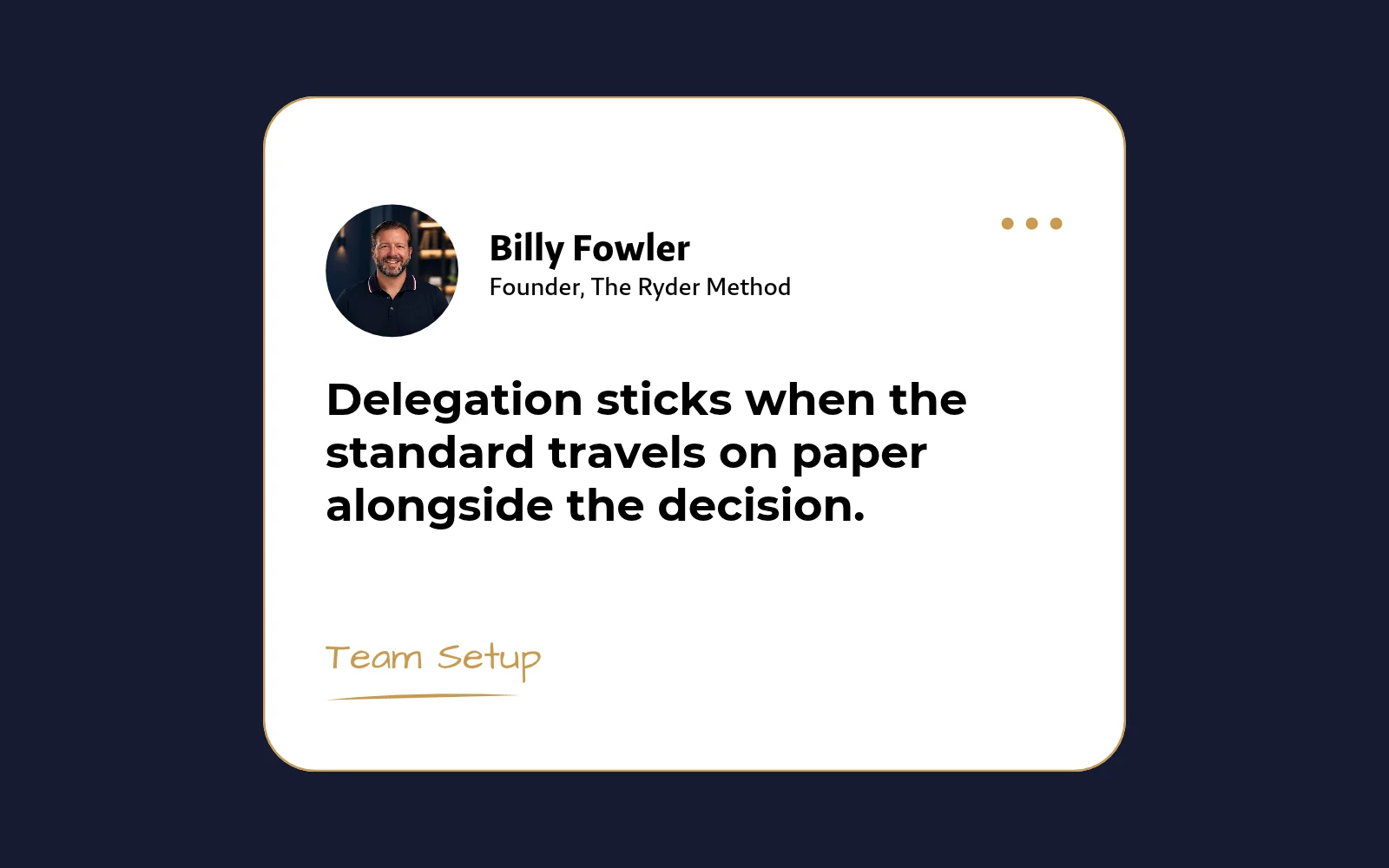
Delegation sticks when the standard travels on paper alongside the decision.
How unwritten decision rights turn capable leads into bottlenecks
A business is one connected system. A visible symptom in one pillar rarely starts there. When founders feel buried in approvals, it is tempting to question whether their leads lack initiative—or to go shopping for a senior executive hire before fixing how authority works inside the company.
"You do not have a people problem. You have a decision-rights gap. Without written standards and clear escalation guardrails on paper, capable team members default to waiting on your desk."
Think about how a conscientious manager behaves when boundaries are unspoken. If approving a small client credit, adjusting a delivery date, or swapping a vendor could accidentally cross an invisible line in the founder's head, the safest move for a loyal employee is to pause and ask you first. Multiply that sensible hesitation across eight or twenty people, and your calendar fills with ten-minute interruptions that fracture your strategic attention all week.
Notice how Team Setup sits second in Ryder's foundational sequence when several pillars face equal pressure: Cash Flow and Projections comes first to stabilize visibility and runway, and Team Setup follows right behind it before Operational Efficiency, Target Market, Strategy, Culture, and Big Show Event. Until key leads own clear decisions on paper, every new workflow in Operational Efficiency and every 90-day priority in Strategy still funnels through one exhausted desk.
A quick self-check on how decisions move through your team
Diagnosis before prescription. Before restructuring your org chart or posting a new management role, check how ownership actually operates on an ordinary week. Rate the two Business Bottleneck Test statements below honestly from "Rarely true today" to "Consistently true today":
- "Key team leads own clear outcomes and make routine decisions without escalating to my desk."
- "Core roles have written standards on paper, so I rarely take delegated work back to rewrite or finish myself."
Now look back over the past five workdays and answer four specific diagnostic checks:
- How many deliverables did you personally edit, re-price, or finish after hours this week rather than returning them to the owner with clear feedback?
- If you asked two of your leads right now to write down the exact dollar threshold or risk boundary where they must check in with you, would their answers match yours?
- When someone brings a problem to your desk, do they arrive with a recommended call inside agreed guardrails, or ask "How do you want me to handle this?"
- For your three highest-paid roles, does a single written page define the measurable outcomes they own—separate from a list of daily tasks?
Founder dependency is a structural design gap, never a character flaw—and every "yes" to unwritten rules points directly to a missing page of structure.
Four steps to transfer a decision so it never boomerangs back
Effort built the business. Structure scales it. You do not need a fifty-page employee handbook to get out of daily decision traffic. You need a calm, repeatable handoff discipline applied one recurring decision at a time.
1. Choose the right first decision to transfer
Founders often sabotage delegation by starting with a high-stakes, once-a-year strategic bet where a mistake would hurt the company. Start instead with a high-frequency, bounded recurring decision—something that crosses your desk at least three times a week and follows rules you already apply instinctively, such as standard client concessions, project timeline adjustments, routine vendor purchases, or standard proposal pricing.
2. Define the outcome rather than scripting every keystroke
Capable leads shrink when handed a rigid checklist of micro-tasks, and stall when handed a vague wish. Name the concrete result the decision is meant to protect—for instance, "Resolve client scheduling conflicts within twenty-four hours while protecting gross margin and keeping the account healthy." When a lead understands the outcome they own, they can exercise real judgment inside the lane.
3. Write a half-page decision brief before handing it over
Take fifteen minutes to pull your unwritten mental rubric onto half a page: what a finished decision looks like when done well, the non-negotiable guardrails that can never be crossed, and the exact trigger that requires checking in with you. Attach one real past example that met your bar so "good" is visible rather than abstract.
4. Review the standard without taking back the keyboard
The first two times your lead runs with the new brief, schedule an early check-in well before the external deadline so you are never trapped into a late-night rescue. If the work comes back short of the mark, resist touching the document yourself. Point to the exact line on the half-page brief that missed—or add the missing rule you forgot to write down—and hand the file straight back for them to close.
Copy this half-page decision brief and fill it out with your lead in fifteen minutes:
- Decision and single owner: Exact recurring call being transferred and the one person who owns it (never two names).
- Outcome owned: The result this decision protects for the client, the team, and the company.
- What good looks like: Three observable markers of a well-made call, paired with one real past example that hit the standard.
- What cannot go wrong (hard guardrails): Non-negotiable floors on margin, client commitments, compliance, cash spend, or brand tone.
- Full-freedom zone vs. check-in trigger: Everything the owner decides solo without asking, and the exact threshold where they bring a recommendation to your desk.
- Review rhythm: How we will review the last five calls made under this brief during our weekly fifteen-minute check-in, without transferring the decision back.
What transferring real decision ownership looks like
An illustrative example: Consider the founder of an established architectural and engineering services firm with thirty employees and three studio leads. Every week, change-order requests and fee adjustments from active projects piled up in his inbox, stalling field progress while studio leads waited for his personal sign-off and forcing him to review scope sheets every Sunday evening.
Earlier attempts to tell his studio leads "handle the small change orders yourselves" had backfired twice when a lead gave away unbilled design hours to keep a client happy, pulling the founder right back into inspecting every request. Instead of abandoning delegation, he sat down with his leads and wrote a half-page decision brief for project change orders.
The brief stated what good looked like (written client sign-off before extra hours started), what could never go wrong (never dropping below the firm's target gross margin floor or altering structural liability terms), and a clear check-in line above a set fee threshold. Over the first month, whenever a lead brought him a routine change order out of habit, he asked "Which guardrail on our half-page brief does this cross, and what is your call?" Within weeks, routine change orders moved without touching his desk, margin held firmer than before, and his Sunday evenings returned to his family.
The goal is a company that can carry more of itself.
Four delegation mistakes that pull founders back into daily traffic
The right move at the wrong time creates a new problem. As you shift decisions off your desk, avoid four traps that quietly undo Team Setup progress.
Hiring a senior manager to rescue undocumented chaos. Bringing in an expensive operations director before you clarify core decision rights simply gives you a higher-paid person who still has to ask what lives in your head.
Putting two names beside one outcome. Shared ownership feels collaborative in a meeting, yet on Friday afternoon two owners mean neither person feels final authority—so the decision drifts right back up to you.
Answering quick Slack pings on decisions you already transferred. Every time you give an instant off-the-cuff answer to a question covered by a lead's brief, you bypass your own structure and reward hesitation over judgment.
Waiting until the final deadline hour to review early reps. Reviewing a newly transferred decision ten minutes before it goes to a client leaves zero room to coach, guaranteeing you will grab the wheel and rewrite it yourself.
Reflection: your one Monday-morning action
"Choose one recurring decision you made at least three times this week. Write three lines on half a page—what good looks like, what cannot go wrong, and when to check in—and hand ownership of that decision to a lead."
Do not wait until you have time to rewrite every job description in the company. Transferring one real recurring decision on half a page proves to both you and your lead that your standard can live outside your head—and frees immediate mental bandwidth to transfer the next one.
Frequently asked questions about delegating decisions to your team
What is the difference between delegating a task and delegating an outcome?
Delegating a task hands over an isolated activity—like drafting an email or pulling numbers—while keeping the final judgment on the founder's desk. Delegating an outcome transfers responsibility for a complete result alongside written quality criteria and clear guardrails, allowing a team lead to decide, execute, and close the loop independently.
How do I stop rewriting my team's work when it comes back incomplete?
Build an earlier review buffer before external deadlines so you are never forced into an emergency rescue. When a draft misses the mark, keep your hands off the document. Identify which written standard or guardrail was unclear, update the half-page brief together, and let the owner complete the revision so ownership stays intact.
Which decisions should a founder delegate first?
Start with high-frequency, reversible decisions that interrupt your week three or more times and already follow predictable rules in your head—such as standard proposal pricing within margin bounds, scheduling adjustments, minor client credits, or routine vendor approvals. Hold irreversible, company-shaping bets until repeatable operating decisions run cleanly without you.
Should I hire an operations manager if my team keeps waiting on me?
Not before defining decision rights and role standards for the team you already have. If unwritten expectations are forcing capable staff to escalate routine choices today, a new manager will inherit the exact same ambiguity. Clarifying outcomes and escalation guardrails first often unlocks leadership capacity already sitting on your payroll.
See how your seven pillars connect before you reorganize
Order matters more than effort. Sometimes Team Setup is the primary constraint keeping every decision tethered to your desk. Other times, your leads hesitate because Strategy has six competing initiatives running on the same Monday morning, Cash Flow and Projections is too tight to tolerate small learning mistakes, or Operational Efficiency lacks clear handoffs between departments.
Owner doesn't mean absent. It means choice. Where the Science of Business meets the Art of Living Fully, we guide founders through four clear steps—1) Get oriented, 2) See the full picture, 3) Know what matters now, and 4) Implement, measure, and adjust—with experienced human judgment beside you. Diagnose. Sequence. Implement.
Know what's creating the drag. Know where to begin. Take the ten-minute Business Bottleneck Test across seven connected pillars to see where pressure is collecting in your company, and your clearest starting point. Ten minutes, seven pillars, no sales pitch. Build the company. Become the owner.